


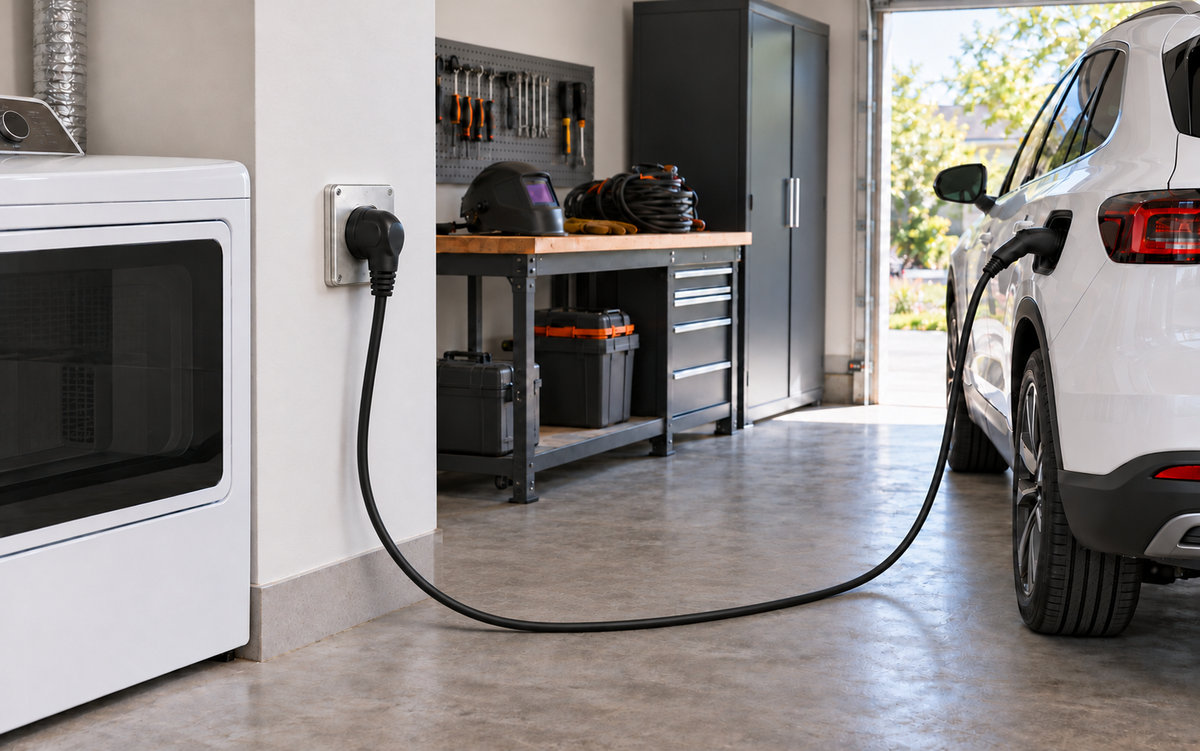
A dryer outlet can support more than a clothes dryer when the outlet type, adapter, and connected equipment are matched correctly. The two 30-amp dryer configurations covered here, NEMA 10-30 and NEMA 14-30, can be used with specific AC WORKS® adapters for EV charging and compatible welding equipment.
What Makes a Dryer Outlet Versatile?
Dryer outlets provide a 30-amp power source, but the connector style matters. Before choosing an adapter, identify which receptacle is installed and which plug your equipment uses.
- NEMA 10-30: The older three-prong style has two hot pins and one neutral.
- NEMA 14-30: The newer four-prong style has two hot pins, one neutral, and one ground.
Because the two configurations are different, the adapter must match the outlet and the equipment. AC WORKS® also offers dryer adapter options for old-to-new and new-to-old connections.
Using a Dryer Outlet for EV Charging
The transcript identifies EV charging as a growing use for dryer outlets. For a NEMA 10-30 outlet, the EV1030MS charging adapter is the referenced option. For a NEMA 14-30 outlet, the corresponding option is the EV1430MS-018 charging adapter.
For the charging setup described in the transcript, set the charging limit to 24 amps and confirm that setting before charging. Even if a vehicle may set the limit automatically, double-checking the value helps keep the load within the 30-amp dryer circuit described.
- Identify whether the wall outlet is NEMA 10-30 or NEMA 14-30.
- Match the adapter to the outlet and the EV charging connector.
- Set and verify the 24-amp charging limit described for this setup.
- Inspect the outlet, plug, and cable before use.
Using a Dryer Outlet for Welding Equipment
A dryer outlet may also be adapted for compatible welding equipment. The transcript discusses 6-50 and 10-50 welder plugs and names WD14301050, WD1030650, and WD1430650 as adapter examples. Browse AC WORKS® welder adapters and power cords to compare the connection types referenced in this article.
Do not choose an adapter by appearance alone. Confirm the NEMA configuration on the dryer outlet, the welder plug, and the adapter before connecting equipment.
How to Choose the Right Dryer Outlet Adapter
- Read the outlet configuration. Determine whether the receptacle is NEMA 10-30 or NEMA 14-30.
- Read the equipment plug configuration. Identify the connector required by the EV charger or welder.
- Match both ends. Select an adapter whose plug matches the dryer outlet and whose connector matches the equipment.
- Respect the circuit limit. For the EV charging setup in the transcript, use the stated 24-amp charging limit.
- Check the condition of the equipment. Do not use damaged plugs, loose receptacles, or worn cables.
If the outlet type, grounding, wiring condition, or circuit capacity is uncertain, stop and consult a licensed electrician. Do not modify a receptacle or wiring to force an incompatible connection.
Frequently Asked Questions
Can a dryer outlet be used for EV charging?
Yes, when the dryer outlet and charging equipment are connected with the correct adapter. The transcript identifies EV1030MS for a NEMA 10-30 outlet and EV1430MS for a NEMA 14-30 outlet, with the charging limit set to 24 amps for the setup described.
What is the difference between NEMA 10-30 and NEMA 14-30?
Both are 30-amp dryer configurations. NEMA 10-30 is the older three-prong style with two hot pins and one neutral. NEMA 14-30 is the newer four-prong style with two hot pins, one neutral, and one ground.
Can a dryer outlet power a welder?
The transcript describes adapting dryer outlets for compatible welding equipment with 6-50 or 10-50 plugs. The outlet, adapter, and welder plug must all be matched by NEMA configuration.
Why is the EV charging limit set to 24 amps?
The transcript instructs users to set the charging limit to 24 amps when using the dryer-outlet charging adapters described. Always verify the setting before charging.
When should I call a licensed electrician?
Consult a licensed electrician when you cannot confirm the outlet type, grounding, wiring condition, or circuit capacity, or when the receptacle is loose, damaged, or shows signs of overheating.

Share:
Does a 50-Amp Inlet Adapter Need a Ring? SS2-50 vs CS6364 Explained