


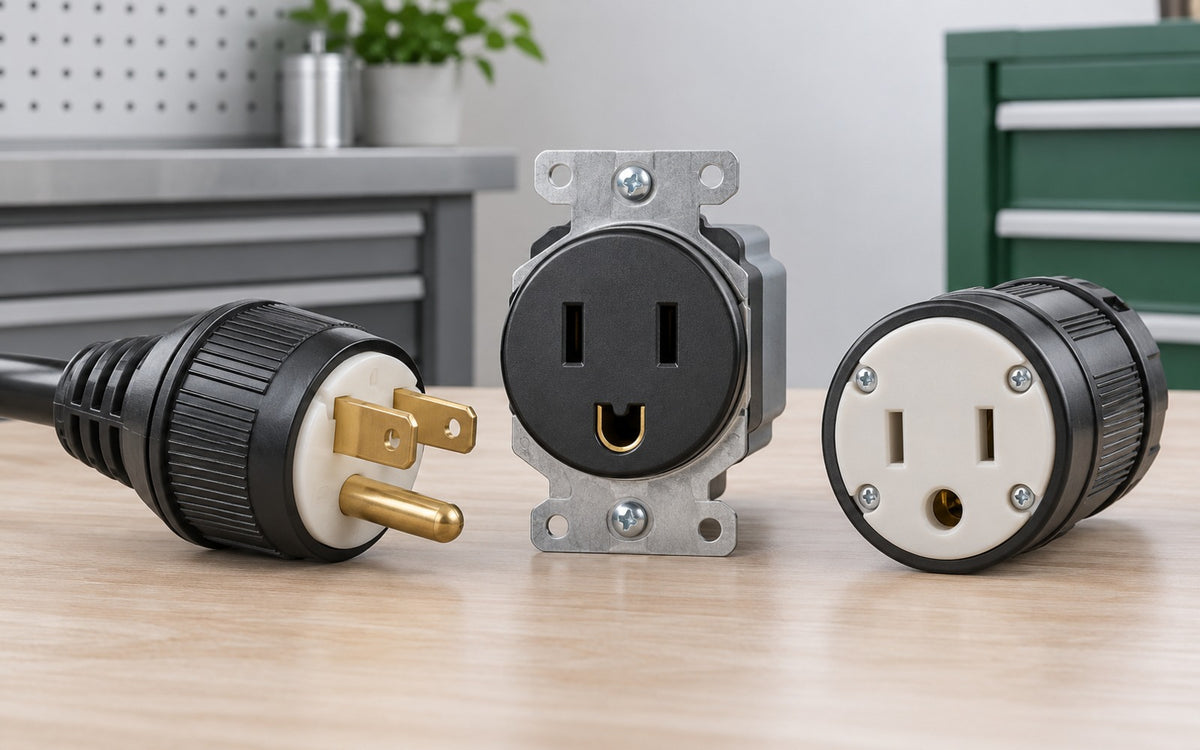
Yes, in many common connections a U-shaped ground opening can accept either a round grounding pin or a U-shaped ground contact. A fully round ground opening accepts a round pin, while a U-shaped ground contact may or may not fit that round opening depending on the specific plug or connector.
Short Answer: U-Ground and Round Ground Compatibility
The ground shape on the receptacle side matters. The common U-shaped ground opening is designed to accommodate both a round ground pin and a U-shaped ground contact. A circular ground opening is more limited: it accepts a round pin, but compatibility with a U-shaped ground contact depends on the exact connection.
That makes the U-shaped opening the more flexible of the two shapes. It does not mean every plug and outlet with a similar-looking ground are automatically compatible. Always identify the complete connection before use.
What Is a U-Shaped Ground?
A U-shaped ground is the familiar curved ground opening seen on many outlets, connectors, adapters, and cords. It is the more common shape and appears across everyday household outlets as well as configurations such as TT-30 and 6-50 connections.
The key feature is its open U-shaped profile. That profile can receive a round grounding pin, and it can also receive a matching U-shaped grounding contact.
How the Two Ground Shapes Fit
Use the ground opening on the receptacle or connector as the starting point:
- U-shaped ground opening + round ground pin: compatible at the ground position.
- U-shaped ground opening + U-shaped ground contact: compatible at the ground position.
- Round ground opening + round ground pin: compatible at the ground position.
- Round ground opening + U-shaped ground contact: fit depends on the specific plug or connector.
Round ground openings are less common. When one is present, do not assume a U-shaped ground contact will fit and never force the connection.
How to Check a Plug and Outlet
A quick visual check can help you understand the ground shape before you connect equipment:
- Look at the entire plug and outlet, not only the ground contact.
- Identify whether the ground opening is U-shaped or fully round.
- If the opening is U-shaped, it can accept a round or U-shaped ground contact at that position.
- If the opening is round, verify the exact plug or connector before attempting a connection.
- Stop if the parts do not align naturally. Do not force or alter a grounding contact.
If the connection is difficult to identify, compare it with the AC WORKS® configuration matching guide or browse the AC WORKS® outlet guide for clear configuration references.
Ground Shape in Adapters and Cords
The same shape question comes up with adapters, connectors, and power cords. U-shaped grounds remain common across these products, so a round grounding pin will often meet a U-shaped ground opening. When a fully round ground opening is present, confirm the specific connector rather than relying on appearance alone.
Ground shape answers only one part of the fit question. The complete plug and receptacle still need to match. If you are uncertain about the outlet, wiring condition, or the correct connection for your equipment, ask a licensed electrician to evaluate it.
Electrical Safety
Grounding is a safety feature, so the connection should never be improvised. Review the AC WORKS® safety guide and follow these basic precautions:
- Do not force a plug into an opening that does not accept it naturally.
- Do not bend, remove, or reshape a grounding contact to make it fit.
- Use a licensed electrician when the outlet, connector, or wiring condition is uncertain.
The Bottom Line
A U-shaped ground opening generally accepts both round and U-shaped grounding contacts. A round opening accepts a round pin, while a U-shaped contact may fit only certain round openings. Check the complete connection, avoid forcing any part, and get professional help when compatibility is unclear.
Frequently Asked Questions
Can a round ground pin fit into a U-shaped ground opening?
Yes. The U-shaped ground opening can accept a round grounding pin.
Can a U-shaped ground contact fit into a round ground opening?
It depends on the specific plug or connector. Some combinations may fit, but you should not assume they will or force the connection.
Where are U-shaped grounds commonly found?
They are common on household outlets and also appear on connections such as TT-30 and 6-50, as well as on many adapters, connectors, and cords.
Does matching the ground shape confirm the whole plug is compatible?
No. Ground shape is only one part of the connection. Identify the complete plug and receptacle before use.
When should I call a licensed electrician?
Call a licensed electrician when you cannot confidently identify the connection, when the parts do not align naturally, or when the outlet or wiring condition is uncertain.
Share:
NEMA 6-15 vs. NEMA 6-30: How to Tell These 250V Plugs Apart
30 Amp vs. 50 Amp RV Power: Outlet and Adapter Output Guide