


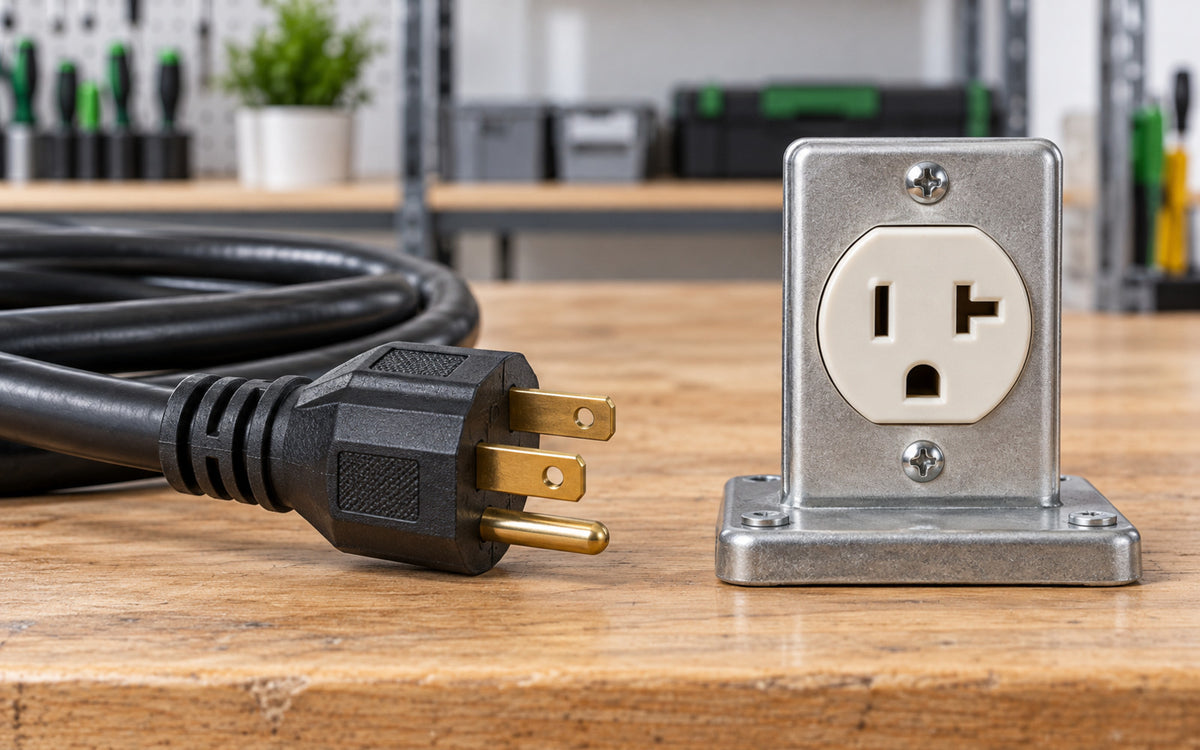
A NEMA 5-15 plug is normally associated with 15-amp, 125-volt service, but plug shape alone does not establish the safe capacity of a complete cord or adapter. According to AC WORKS®, certain specifically identified AC WORKS® assemblies use 12-gauge or larger cable and are engineered for higher-capacity use from a NEMA 5-15 outlet. That does not make every 5-15 product a 20-amp product. Use the capacity printed for the complete assembly, stay within the outlet and circuit limits, and never extend this guidance to another brand or an unverified cord.
Why a 5-15 Plug Can Create Confusion
The question usually starts with a mismatch in appearance: a cord has a familiar NEMA 5-15P household-style plug, while the connector on the other end may be associated with a higher amperage. Because the output connector looks larger or carries a higher rating, it is easy to assume either that the cord cannot use the available power or that the connector automatically increases capacity. Neither conclusion should be based on appearance alone.
The complete assembly matters. Plug construction, conductor size, the supplying receptacle, the circuit, and the connected load all have to be evaluated together. The lowest applicable limit still controls the setup.
NEMA 5-15 vs. NEMA 5-20
NEMA 5-15P: The familiar three-prong household-style male plug with two parallel blades and a grounding pin. It is normally associated with 15 amps at 125 volts.
NEMA 5-20P: A 20-amp, 125-volt male plug with one blade turned perpendicular to the other.
NEMA 5-20R: A T-slot receptacle designed to accept either a 5-15P plug or a 5-20P plug. That physical compatibility does not change the rating of the cord or device you connect.
What Determines the Safe Capacity of an Adapter or Cord?
Product-specific rating: Use the maximum capacity stated for the exact cord or adapter.
Wire gauge: In this example, AC WORKS® explains that the S515B515-060 uses 12-gauge cable. Other specifically identified AC WORKS® adapters may use 14-gauge or 10-gauge cable.
Connector construction: The transcript notes that the 5-15 plug used on the identified AC WORKS® products is made with materials intended for the product’s stated service. This is a manufacturer-specific detail, not a universal rule for all 5-15 plugs.
Supplying outlet and circuit: A 5-20 T-slot receptacle may accept a 5-15 plug, but the branch circuit and receptacle still set limits that cannot be exceeded.
Connected load: The combined current of everything connected must remain within the lowest rating in the full power path.
The AC WORKS® S515B515-060 Example
The example uses the AC WORKS® S515B515-060 power strip cord as its primary comparison. It resembles a conventional extension cord with a multi-outlet end, but AC WORKS® specifies 12-gauge cable inside the assembly. The example explains that this construction is why the identified product can be used from a NEMA 5-20 outlet within the product’s stated limits, even though its male end has a 5-15 pattern.
The important boundary is brand and model specificity. AC WORKS® explicitly limits this explanation to products it makes and identifies. A visually similar cord from another manufacturer may use different wire, terminals, or construction. Do not assume equivalent capacity.
For compatible options, review the AC WORKS® industrial and job-site NEMA 5-15P adapters and confirm the exact product specifications before use.
How to Check a 5-15 Adapter or Cord Before Use
- Identify the source receptacle. A 5-20R has a T-shaped slot and is normally associated with 20-amp, 125-volt service.
- Read the exact product label and instructions. Look for the stated amperage, voltage, and cable construction for the complete assembly.
- Compare every limit in the power path. The outlet, circuit, cord, adapter, connector, and load must all be compatible.
- Add the connected loads. Do not exceed the lowest rated component, even when a receptacle can physically accept the plug.
- Stop if the setup is unclear. A licensed electrician should inspect uncertain circuit ratings, loose or damaged receptacles, signs of overheating, or repeated breaker trips. Do not modify plugs, receptacles, or wiring to force compatibility.
The Practical Rule
A plug fitting into a receptacle proves only physical compatibility. Safe capacity comes from the rating and construction of the complete, specifically identified product and the limits of the supplying circuit. For AC WORKS® equipment, verify the model’s current specifications; for any other brand, use that manufacturer’s documentation rather than applying this blog’s explanation.
Frequently Asked Questions
Can every NEMA 5-15 plug handle 20 amps?
No. A standard 5-15 plug should not be assumed to support 20 amps. The blog describes only certain specifically identified AC WORKS® assemblies whose complete construction is intended for higher-capacity service. Follow the rating for the exact product.
Why does a 5-15 plug fit a 5-20 outlet?
A NEMA 5-20R uses a T-shaped slot that accepts both 5-15P and 5-20P plugs. That fit does not automatically raise the connected product’s rating.
Does a 20- or 30-amp female connector on the other end increase input capacity?
No. A higher-rated connector does not override a lower limit elsewhere in the power path. The full assembly and the connected load must stay within the lowest applicable rating.
Why does wire gauge matter?
Conductor size is one part of a cord’s capacity. In the blog's example, the S515B515-060 uses 12-gauge cable, while some other identified AC WORKS® adapters use 14-gauge or 10-gauge cable. Wire gauge alone still does not replace the complete product rating.
Can I apply this guidance to another brand?
No. The blog explicitly limits the explanation to AC WORKS® products that are built and rated for the described use. Check other manufacturer’s label and instructions or consult a licensed electrician.
Share:
Welding Plug Adapters: How to Choose the Right NEMA Connection