


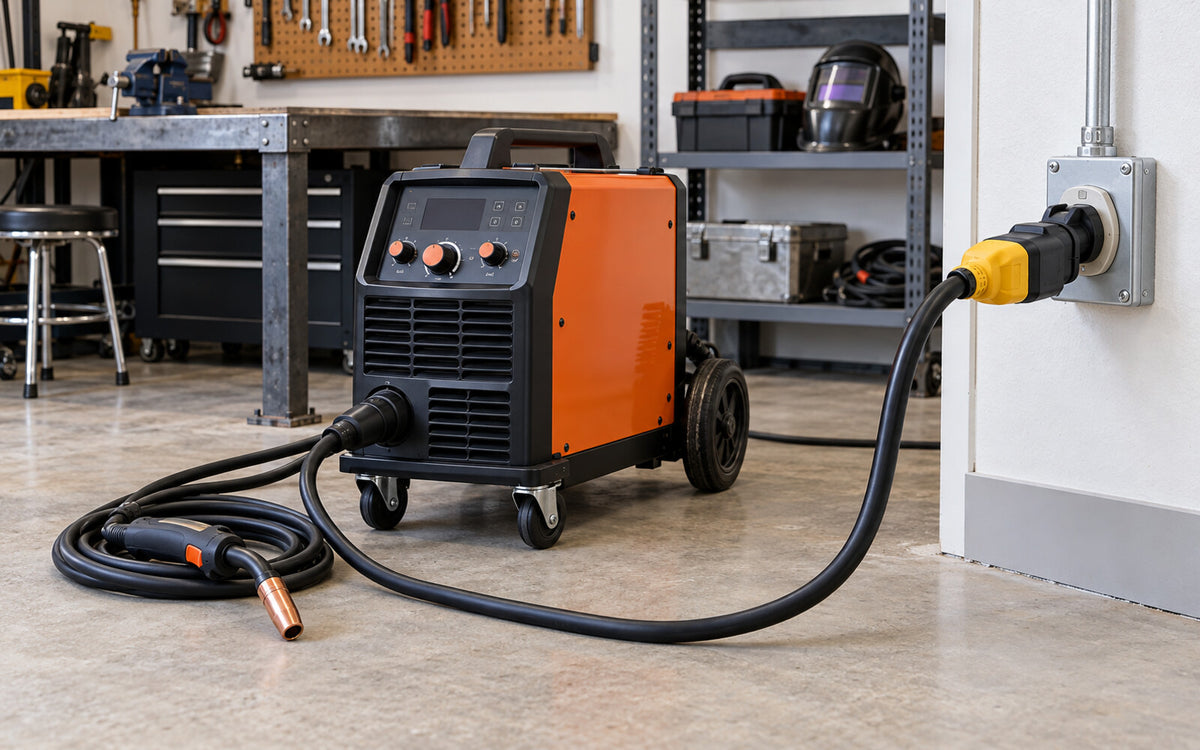
The right welding plug adapter connects your welder’s plug to an available power source while staying within the power requirements in the welder’s user manual. Start by identifying both connection types, then confirm the minimum power the welder needs and the maximum it can accept before choosing an adapter.
Start With the Welder’s Power Requirements
Before comparing plug shapes or adapter styles, read the welding machine’s user manual. The manual is the source for the machine’s minimum power requirement and maximum supported power. Many welders also include a dial or control knob that lets the operator adjust the power for the project.
Record these details before selecting an adapter:
- The welder’s minimum power requirement
- The welder’s maximum supported power
- The NEMA configuration on the welder’s plug
- The NEMA configuration of the available outlet
Common Welder Plug Types
The transcript identifies two plug configurations commonly found on welding machines:
- NEMA 6-50, commonly found on newer welders
- NEMA 10-50, commonly found on older welders
Do not choose by the number of prongs alone. Use the NEMA configuration for the welder plug and the available outlet so the two ends of the adapter match the actual equipment.
Common Power Sources You May Be Able to Adapt
Many homes do not have a dedicated welder outlet. The transcript notes two other high-power outlet types that may be available:
- NEMA 14-30 dryer outlet
- NEMA 14-50 range outlet
An available outlet is only one part of the decision. Its configuration and the welder’s stated power requirements must both be considered. An adapter changes the connection format; it does not replace the need to verify the circuit and equipment requirements.
How to Choose a Welding Plug Adapter
Use this sequence to narrow the options without guessing:
- Check the welder’s user manual for minimum and maximum power requirements.
- Identify the NEMA number on the welder plug, such as 6-50 or 10-50.
- Identify the available power-source outlet, such as 14-30 or 14-50.
- Choose an adapter whose plug end matches the source outlet and whose receptacle end matches the welder plug.
- Set and operate the welder only within the limits stated by its manufacturer and the available circuit.
You can browse AC WORKS® welder adapters by category, then filter by the plug end and receptacle end required for the setup. If a configuration is difficult to identify visually, use the AC WORKS® configuration matching guide before selecting an adapter.
Examples Mentioned in the Transcript
The source transcript references several AC WORKS® adapter families for connecting common dryer, range, generator, and welder configurations. The key lesson is to read each model by its two connection ends rather than relying only on a product name. For example, a 14-30 source-to-6-50 welder adapter serves a different connection pair than a 14-50 source-to-10-50 welder adapter.
Electrical Safety Before You Connect
High-power welding equipment requires careful verification. Stop and consult a licensed electrician when the outlet identity, circuit rating, wiring condition, grounding, or compatibility is uncertain. Do not modify a plug, receptacle, circuit, or adapter to force a connection.
- Inspect the plug, outlet, adapter, and cord before use.
- Do not use equipment with visible damage, looseness, overheating, or exposed conductors.
- Keep every connection within the welder manufacturer’s requirements and the circuit’s limits.
- Have a licensed electrician evaluate any questionable or newly installed power source.
Frequently Asked Questions
What should I check before buying a welding plug adapter?
Check the welder’s user manual for its minimum and maximum power requirements. Then identify the NEMA configuration on the welder plug and on the available outlet.
What plug types are common on welders?
The transcript identifies NEMA 6-50 as common on newer welders and NEMA 10-50 as common on older welders.
Can a dryer or range outlet power a welder through an adapter?
A NEMA 14-30 dryer outlet or NEMA 14-50 range outlet may be adaptable for some welding setups, but the connection type and the welder’s stated power requirements must match. When compatibility is uncertain, ask a licensed electrician.
How do I know which end of the adapter I need?
The adapter’s plug end must match the available power-source outlet. Its receptacle end must match the welder’s plug.
Does an adapter change the welder’s power requirements?
No. Select and operate the welder according to the requirements in its user manual and the limits of the available circuit.
Share:
How to Reduce Voltage Drop in Long Extension Cords: Wire Gauge Guide