

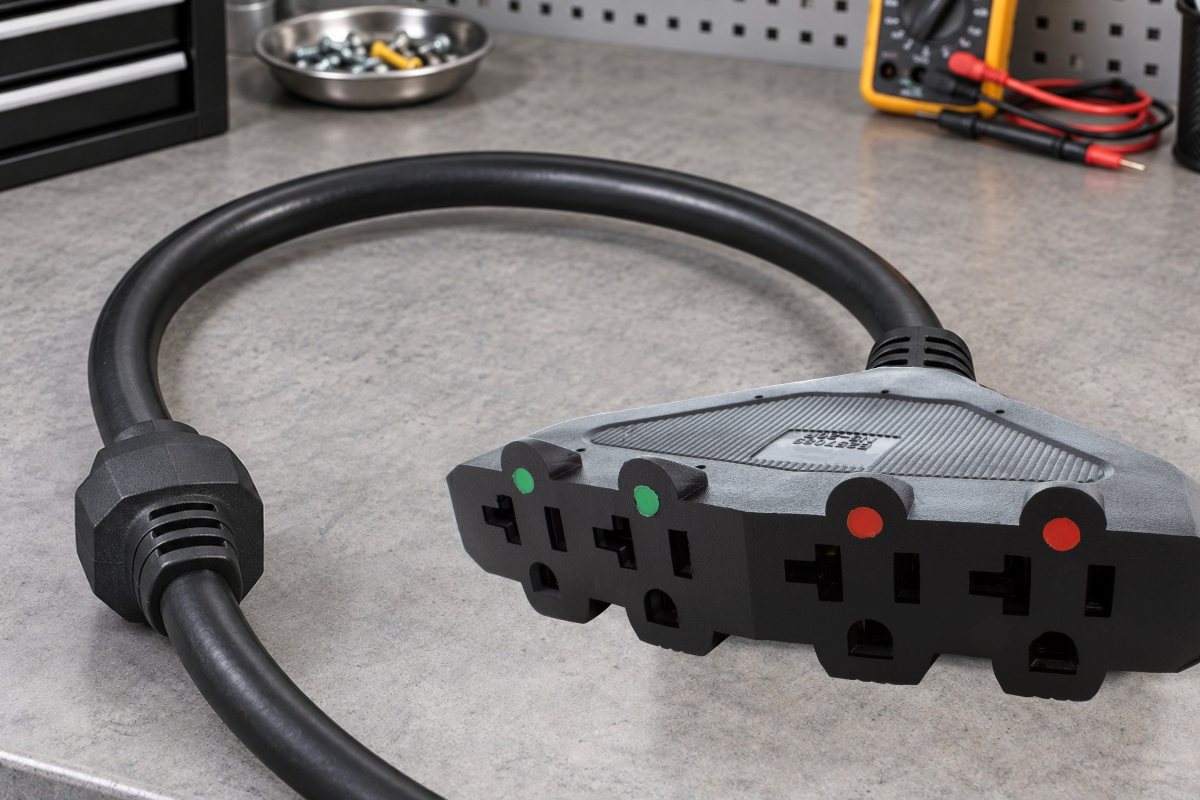
Short answer: The red and green dots identify which pair of 120-volt receptacles is connected to each of the two hot legs in a four-wire power distribution adapter. On the AC WORKS® S1450F520-018, the two green-marked outlets share one hot leg, while the two red-marked outlets share the other. The colors help you distribute connected equipment between the two legs; they do not create extra capacity.
That distinction matters because the source connection, the built-in cable, each outlet, and the combined load all have ratings that must be respected. The colors make the electrical layout easier to see before you connect equipment.
What the Red and Green Dots Identify
The dots are a simple map of the adapter’s two hot legs. Using the S1450F520-018 as the example, the NEMA 14-50 plug has two hot pins. At the distribution end, the adapter provides four NEMA 5-20 receptacles arranged as two color-coded pairs:
- Two green-marked receptacles are supplied by one hot leg.
- Two red-marked receptacles are supplied by the other hot leg.
- The color groups help show where connected loads are assigned.
See the AC WORKS® S1450F520-018 power distribution adapter for the referenced configuration, or review the AC WORKS® NEMA configuration guide to compare common plug and receptacle layouts.
How the Two Hot Legs Feed Four Outlets
The four receptacles do not operate as four unrelated 20-amp circuits. Each individual NEMA 5-20 receptacle is rated for 20 amps, but the two receptacles with the same color share one hot leg. In this adapter, the built-in 10-gauge cable allows up to 30 amps on each hot leg.
That means the two green outlets must stay within their shared 30-amp allowance, and the two red outlets must do the same. Adding four 20-amp outlet ratings together would give the wrong picture because it ignores how the outlets are grouped and how the cable is rated.
For more context on the downstream connection, see the AC WORKS® NEMA 5-20 outlet solutions guide.
How to Distribute Equipment Between the Colors
Use the colors to spread higher-demand equipment between the two hot legs. The transcript’s example is straightforward: if two pieces of equipment each need 20 amps, connect one to a green-marked outlet and one to a red-marked outlet. That places one 20-amp load on each hot leg and leaves 10 amps available on each leg within the adapter cable’s stated 30-amp-per-leg limit.
A practical planning sequence is:
- Identify the amperage required by each piece of equipment.
- Group the two green outlets as one shared hot leg and the two red outlets as the other.
- Place high-demand equipment on different color groups when needed.
- Add the loads within each color group and keep each hot leg within the adapter’s limit.
For lighter-duty equipment, either color group can be used as long as the combined load on that group remains within the allowed capacity. The dots are a planning aid, so the important calculation is the total connected load on each color group, not simply the number of open receptacles.
Ratings to Check Before Use
Do not assume the NEMA 14-50 source rating becomes the rating of every downstream connection. In the example from the transcript, the source plug may connect to a range-style outlet capable of 40 to 50 amps, while the adapter’s 10-gauge cable is limited to 30 amps per hot leg and each NEMA 5-20 receptacle is rated for 20 amps.
- Confirm the rating of the source connection.
- Respect the adapter cable’s 30-amp-per-hot-leg limit.
- Keep each individual NEMA 5-20 receptacle within its 20-amp rating.
- Account for all equipment connected to the same red or green group.
Electrical Safety and When to Call an Electrician
Color coding does not replace verification. Use the adapter only with compatible connections and equipment whose electrical requirements are known. If you cannot confirm the outlet configuration, circuit rating, condition of the wiring, or how the planned loads are divided, have a licensed electrician evaluate the setup before use. Do not modify a plug, receptacle, cord, or adapter to force an incompatible connection.
Frequently Asked Questions
Do the red and green dots indicate positive and negative?
No. On this power distribution adapter, the colors identify the two different hot legs. Each color marks the pair of receptacles supplied by the same hot leg.
Can all four 20-amp outlets supply 20 amps at the same time?
Not in the referenced setup. Although each NEMA 5-20 receptacle is rated for 20 amps, each same-color pair shares a hot leg, and the adapter’s cable allows up to 30 amps per hot leg.
Where should I connect two 20-amp pieces of equipment?
Connect one piece of equipment to a green-marked outlet and the other to a red-marked outlet. This distributes one 20-amp load to each hot leg in the example described by the transcript.
Can I use either color for lighter-duty equipment?
Yes, provided the combined load on each color group stays within the adapter’s limit and each individual outlet remains within its rating.
What if I am unsure about my outlet or circuit?
Stop and have a licensed electrician confirm the outlet configuration, circuit rating, wiring condition, and compatibility of the planned equipment.

Share:
Twist-Lock vs. Straight-Blade Connectors: NEMA Plug Basics