


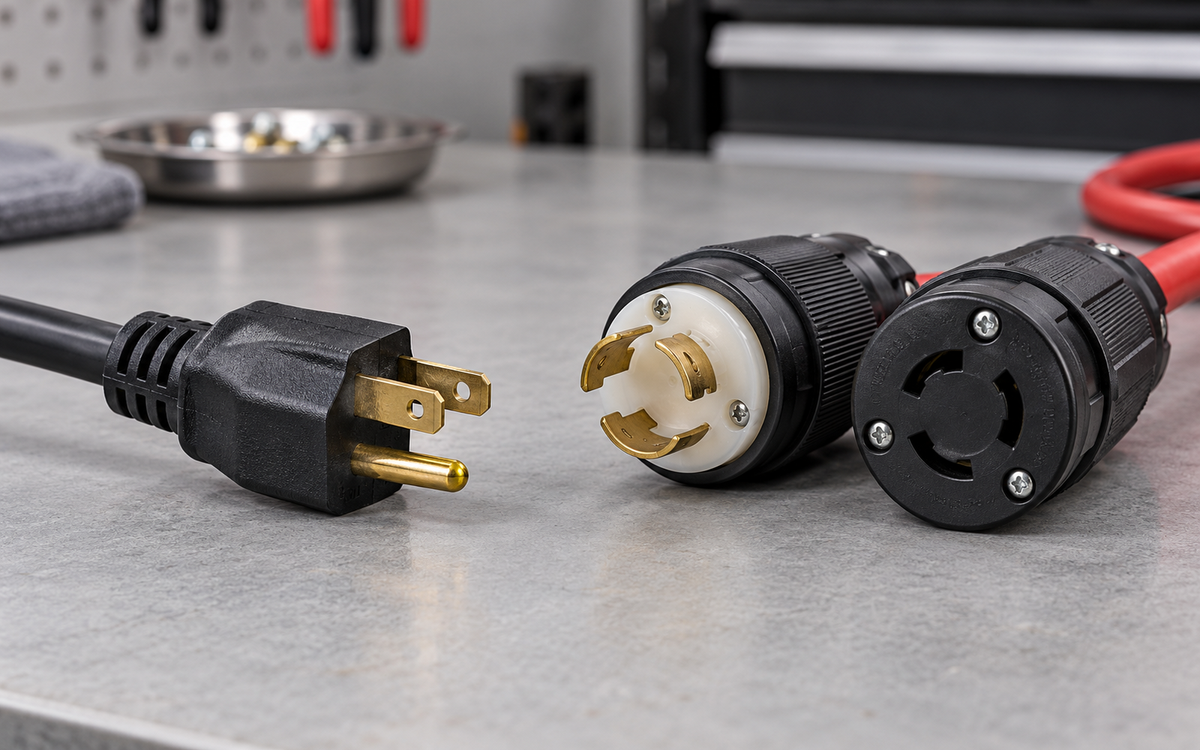
A twist-lock connector uses curved prongs in a circular arrangement and a small clockwise turn to hold the connection in place. A straight-blade plug uses mostly flat, straight prongs and moves directly in and out. The visual difference makes the two NEMA connection families easier to recognize.
What Is the Difference Between Twist-Lock and Straight-Blade Connectors?
The simplest difference is the shape and motion of the connection. Straight-blade plugs insert directly into a matching receptacle or connector. Twist-lock plugs use curved prongs and a brief clockwise twist after insertion. That twist is only a few degrees, not a half turn.
Both are part of the broader range of NEMA configurations, which can vary by prong count, size, rating, and shape. Start by identifying whether the plug has mostly straight blades or curved prongs arranged around a circle. From there, match the exact configuration rather than judging by overall size alone.
How Straight-Blade Plugs Work
Straight-blade connections are the familiar family used with many everyday appliances and electronics. Their prongs are primarily straight and flat, although a configuration may also include a round or U-shaped ground prong or an L-shaped prong.
Key visual cues:
- The primary blades look straight and flat.
- The plug goes straight into and out of its matching connection.
- A round, U-shaped, or L-shaped prong does not automatically make the entire configuration twist-lock.
How Twist-Lock Plugs and Connectors Work
A twist-lock plug is easy to spot once you know the pattern: its prongs are curved and arranged in a circular formation. After the plug is inserted into the matching connector, a small clockwise turn secures it.
The locking motion is subtle. It takes only a few degrees, so a user who expects a large rotation may not notice that the connection is designed to twist. The same small-turn principle applies across locking plugs and connectors.
Basic connection sequence:
- Identify the curved prongs and circular arrangement.
- Align the plug with its matching connector.
- Insert the plug, then rotate it clockwise only a few degrees to lock it.
- If a plug does not align or turn as expected, stop rather than forcing it.
How to Identify the Two Connector Families
Use this quick comparison when looking at an unfamiliar plug:
- Straight-blade: mostly flat, straight prongs; direct in-and-out motion.
- Twist-lock: curved prongs in a circular pattern; insert and turn slightly clockwise.
The family is only the first step. Prong count, dimensions, ratings, and shapes can still differ within each family. For a visual starting point, use the AC WORKS® outlet solutions guide. You can also read the AC WORKS® overview of locking versus straight-blade connections or browse the locking adapter collection after you have identified the connection you need.
When Is a Locking Connection Useful?
Locking connections are used in settings where continuous power is important and an unintended disconnect would be disruptive. The small twist helps the plug remain secured in its matching connector. Straight-blade connections remain common for familiar household appliances and electronics where the direct in-and-out design is expected.
The connector style should match the actual plug, receptacle, equipment, and electrical requirements. A locking shape is not a substitute for confirming the complete configuration.
Electrical Safety and Correct Matching
Do not force a plug into a connector or alter prongs to make an incompatible configuration fit. De-energize equipment before inspecting a connection, and do not use damaged plugs, connectors, or cords. If you are unsure about an outlet, branch circuit, wiring condition, or the correct configuration for installed equipment, have a licensed electrician evaluate it.
Frequently Asked Questions
What is a twist-lock connector?
A twist-lock connector is part of a locking connection family with curved prongs arranged in a circle. After insertion, a small clockwise turn locks the plug into the matching connector.
How can I tell a twist-lock plug from a straight-blade plug?
Look at the prongs. Twist-lock plugs have curved prongs in a circular arrangement, while straight-blade plugs have mostly straight, flat blades and move directly in and out.
How far do you turn a twist-lock plug?
Only a few degrees. The locking motion is small and should not require anything close to a 180-degree turn.
Are all plugs with a round or L-shaped prong twist-lock?
No. Some straight-blade configurations may include a round or U-shaped ground prong or an L-shaped prong. Identify the overall prong pattern and confirm the complete configuration.
When should I call a licensed electrician?
Use a licensed electrician when you are uncertain about an installed outlet, circuit, wiring condition, damage, or the correct connection for your equipment.


Share:
Food Truck Power Supply Guide: How to Choose a Generator, Cord, and Adapter
What Do Red and Green Dots Mean on a Power Distribution Adapter?