



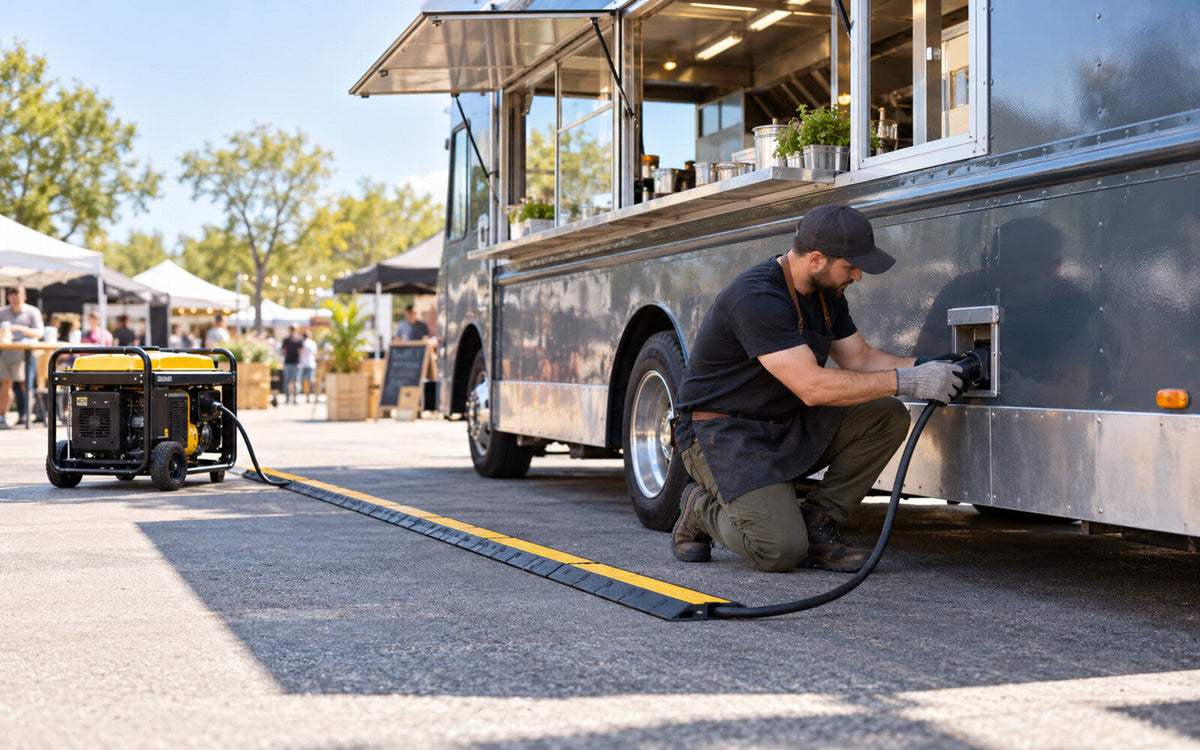
To power a food truck reliably, first total the wattage of the equipment you expect to run, then choose a generator with capacity above that running load. Match the generator outlet, truck inlet, breaker, extension cord, and any adapter by configuration and rating before connecting power.
Start With Your Food Truck’s Power Requirements
Food trucks may need to run grills, fryers, refrigerators, lighting, and ventilation at the same time. The first step is to estimate the combined electrical load instead of choosing a generator by appearance or outlet shape alone.
- List every appliance and system you plan to operate.
- Find the volts and amps shown for each load.
- Calculate watts with the formula: volts × amps = watts.
- Add the running wattage and select a generator that exceeds the total.
Many food trucks use a 50-amp, 125/250-volt inlet. At that rating, the available capacity can be up to 12,500 watts. Your actual plan still needs to reflect the equipment you will run and the capacity available from the generator connection.
Match the Generator Outlet to the Truck Inlet
A generator and food truck do not always use the same connector. Before selecting a cord or adapter, identify both ends of the connection:
- The generator outlet configuration and its voltage/amperage rating
- The food truck inlet configuration and its voltage/amperage rating
- The breaker rating associated with the generator outlet
- The plug and connector configurations on the extension cord or adapter
Matching these details helps you choose a connection that fits the available source and the truck’s inlet without guessing from prong count alone.
50-Amp and L14-30 Food Truck Power Options
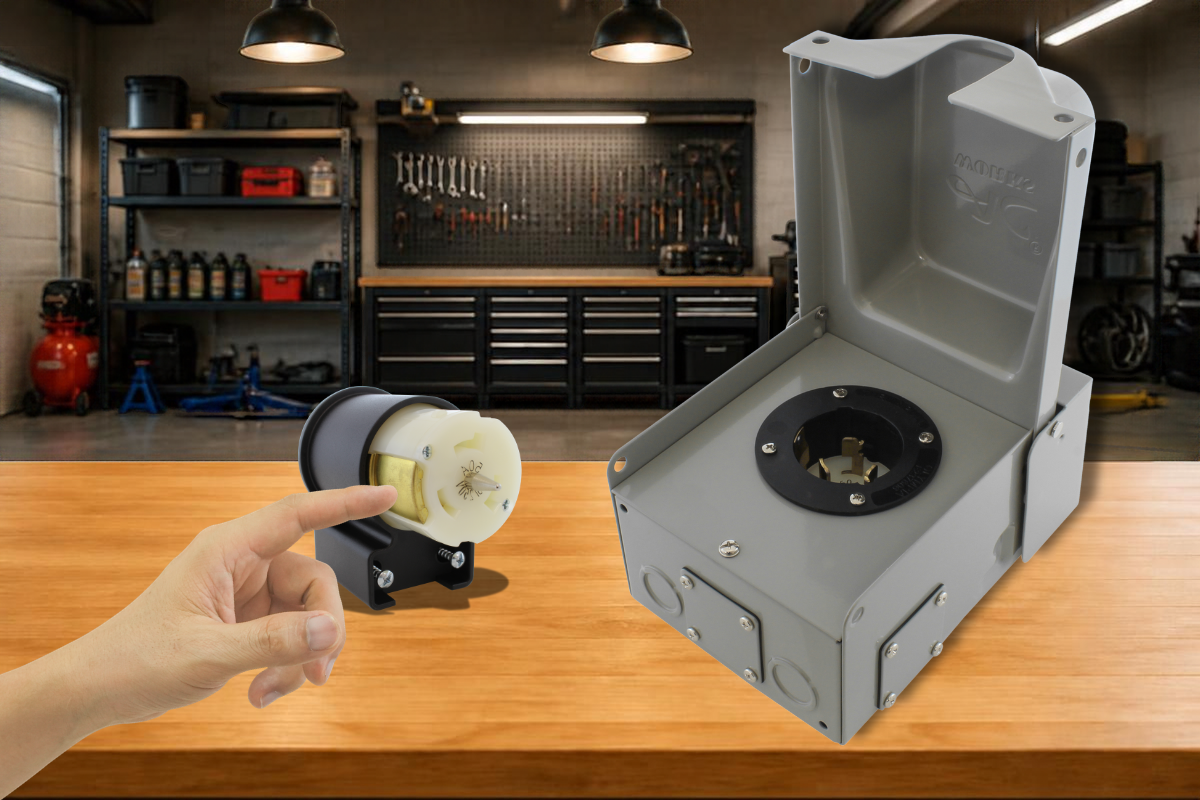
A 50-amp, 125/250-volt connection can support up to 12,500 watts. If the generator does not provide a NEMA 14-50 outlet, a NEMA L14-30 outlet may be an alternative for a truck whose planned load fits that source. The transcript identifies L14-30 as a 30-amp, 125/250-volt connection with capacity up to 7,500 watts.
The key difference is available capacity: a 30-amp L14-30 source does not provide the same wattage as a 50-amp source. Recalculate the planned load for the connection you will actually use.
Choose the Right Cord or Adapter
Most food trucks connect their inlet to the generator with an extension cord. When the generator has an L14-30 outlet and the truck has a 50-amp SS2-50 inlet, the transcript describes several AC WORKS® connection options:
- L1430M50-018: a short flexible adapter for connecting an L14-30 source to a 50-amp-style connection.
- ADL1430SS2: a compact adapter for an L14-30 source and an SS2-50 connection.
- L1430M50: an all-in-one cord-and-adapter solution offered in 10-, 25-, 50-, 75-, and 100-foot lengths.
You can also review AC WORKS® L14-30 outlet solutions or browse food-truck power adapters and cords to compare connection formats. Select by the exact source outlet, truck inlet, and required capacity—not by product name alone.
Food Truck Power Safety
Electrical power for cooking, refrigeration, lighting, and ventilation is a high-consequence system. Confirm connector types and ratings before use, keep every connection consistent with the available generator outlet and breaker, and do not rely on an adapter to change the source’s available capacity.
Ask a licensed electrician to evaluate the setup when the truck inlet, generator outlet, breaker, wiring, or total load is unclear—or when a new inlet or circuit must be installed. Generator operation and placement must also follow the generator manufacturer’s instructions.
Festival-Ready Setup Checklist
- Calculate the combined wattage of the equipment you plan to operate.
- Choose a generator whose capacity exceeds the total running wattage.
- Confirm whether the usable outlet is 50 amp or L14-30.
- Verify the food truck inlet and the required plug/connector configuration.
- Choose a correctly matched extension cord, adapter, or all-in-one cord.
- Have a licensed electrician review any uncertain or newly installed electrical connection.
FAQ
How do I calculate the power my food truck needs?
List the equipment you expect to run, find its voltage and amperage, and use volts × amps = watts. Add the running wattage, then choose a generator with capacity above that total.
How many watts can a 50-amp food truck connection provide?
A 50-amp, 125/250-volt connection can provide up to 12,500 watts. The equipment load and the generator connection still determine what is actually available.
Can an L14-30 generator outlet power a food truck?
It may be an option when the truck’s planned load fits a 30-amp, 125/250-volt source. The transcript identifies the maximum as 7,500 watts, so compare the calculated load with that capacity.
What adapter connects L14-30 power to an SS2-50 inlet?
The transcript identifies the compact AC WORKS® ADL1430SS2 and the flexible L1430M50-018 as options. Verify both ends of the connection and all relevant ratings before use.
When should I call a licensed electrician?
Use a licensed electrician when you cannot confirm the inlet, outlet, breaker, wiring, or load requirements, and whenever a new inlet or circuit needs to be installed.
Share:
Does a Locking 50A 125/250V Connection Have Four Prongs? Hidden Ground Contact.