


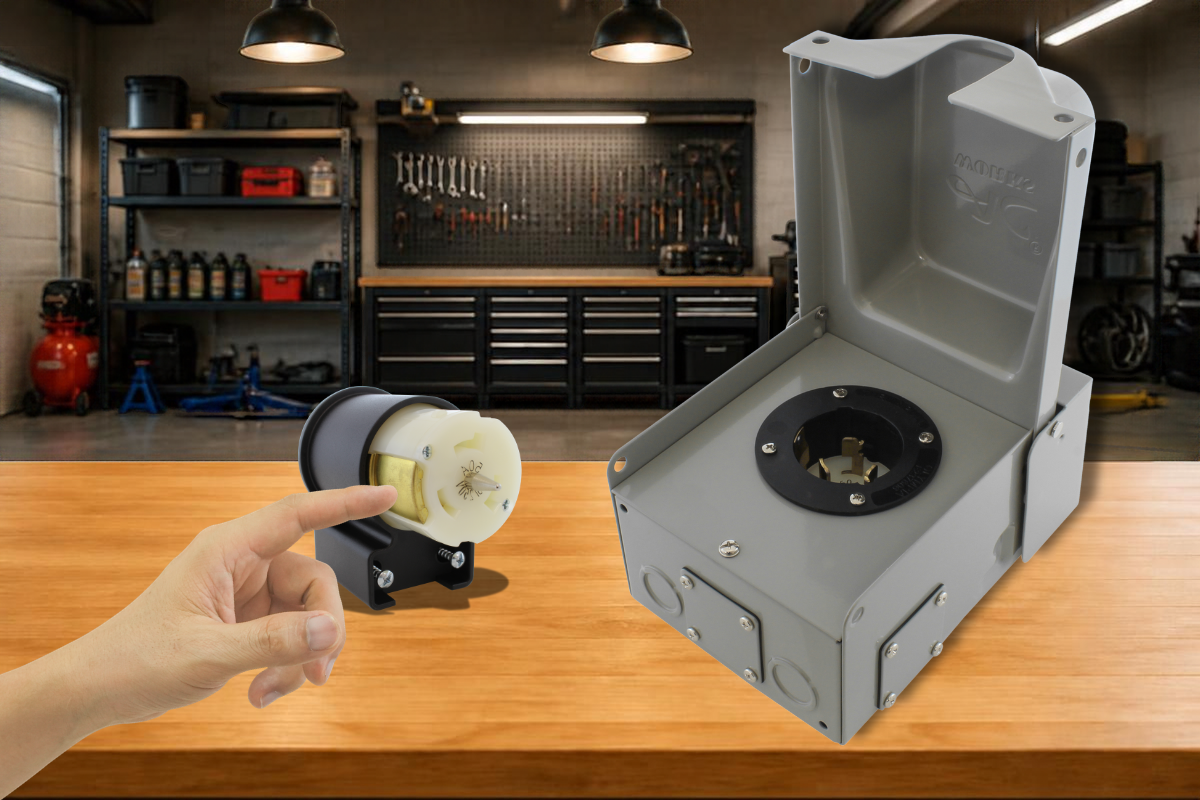
Yes. An SS2-50 connection has four electrical contacts. Three look like familiar projecting contacts, while the fourth is a wider grounding contact built into the inner wall of the circular connection. That wall-mounted contact is easy to overlook, but it is an active part of the four-wire configuration.
Why an SS2-50 Can Look Like a Three-Prong Connection
Most people picture a prong as a blade or pin that sticks out from the face of a plug. On an SS2-50 or related CS63-series locking connection, three contacts match that expectation. The grounding contact has a different shape and sits along the inner wall, so a quick glance can make the connector appear to have only three prongs.
The same visual effect appears across the matching parts described in the AC WORKS® video: a CS6365 plug, a CS6375 inlet, an SS2-50 female connector, and a CS6364 female connector. In each case, the broad copper contact along the wall serves as the fourth contact for grounding.
Where Is the Fourth Prong on an SS2-50 or CS6375?
Look inside the circular connection and find the broad metal contact mounted on the inner wall. It is not decorative and it is not simply part of the housing. It is the grounding contact.
On a plug or inlet, count the three obvious contacts first, then inspect the inside wall for the fourth. On a female connector, look for the larger copper contact positioned along that same wall area. The form is different from a projecting blade, but its grounding role is the reason the connection is correctly described as four-prong and four-wire.
How to Confirm a Four-Wire SS2-50 Connection
Use the visible contact layout and the equipment markings together. The transcript describes these practical checks:
- Count the three conventional blade or pin positions.
- Inspect the inner wall for the broad copper grounding contact.
- Check for the 50 amp, 125/250 volt identification associated with this connection family.
- Review the cable legend when a cord is attached. A four-conductor cable may be marked 6/4. Another construction described in the video is 6/3 plus 8/1, with three 6-gauge conductors and an 8-gauge grounding conductor.
For this dual-voltage connection, the four conductors provide two hot conductors, a neutral, and a ground. That is why the voltage and cable markings can help confirm what the connector face may not make obvious.
Why the Hidden Ground Contact Matters
The inner-wall contact is part of the grounding path, which is a safety function. Treat it as an electrical contact, not as a guide tab or an unused metal insert. A connector should match the intended inlet and electrical configuration; visual similarity alone is not enough to establish compatibility.
Always inspect and identify equipment while it is disconnected and de-energized. If a connector, inlet, cable marking, installation, or wiring arrangement is unclear, stop and have a licensed electrician confirm the configuration. Electrical installation, replacement, and troubleshooting should be handled by a qualified professional.
Related AC WORKS® Resources
See the AC WORKS® CS6375 / SS2-50 inlet box for a close view of this four-contact inlet style. For the matching cord format, explore the AC WORKS® SS2-50 marine power cord.
Frequently Asked Questions
Does an SS2-50 connection really have four prongs?
Yes. Three contacts are easy to see, while the fourth grounding contact is integrated into the inner wall of the circular connection.
Where is the hidden fourth contact?
It is the broad copper-colored contact positioned along the inside wall of the plug, inlet, or matching female connector.
Why does the fourth contact look different?
The grounding contact follows the wall of the circular housing instead of projecting outward like the other contacts. Its shape makes it easy to mistake for part of the body.
Can cable markings help confirm the connection?
Yes. The video identifies four-conductor markings such as 6/4 and a 6/3 plus 8/1 construction, where the separate 8-gauge conductor is the ground.
When should I call a licensed electrician?
Contact a licensed electrician whenever the connector type, cable marking, wiring, installation, or compatibility is uncertain. Do not disassemble or energize an unidentified connection.
Share:
How to Switch From an Electric Stove to a Gas Stove Safely