

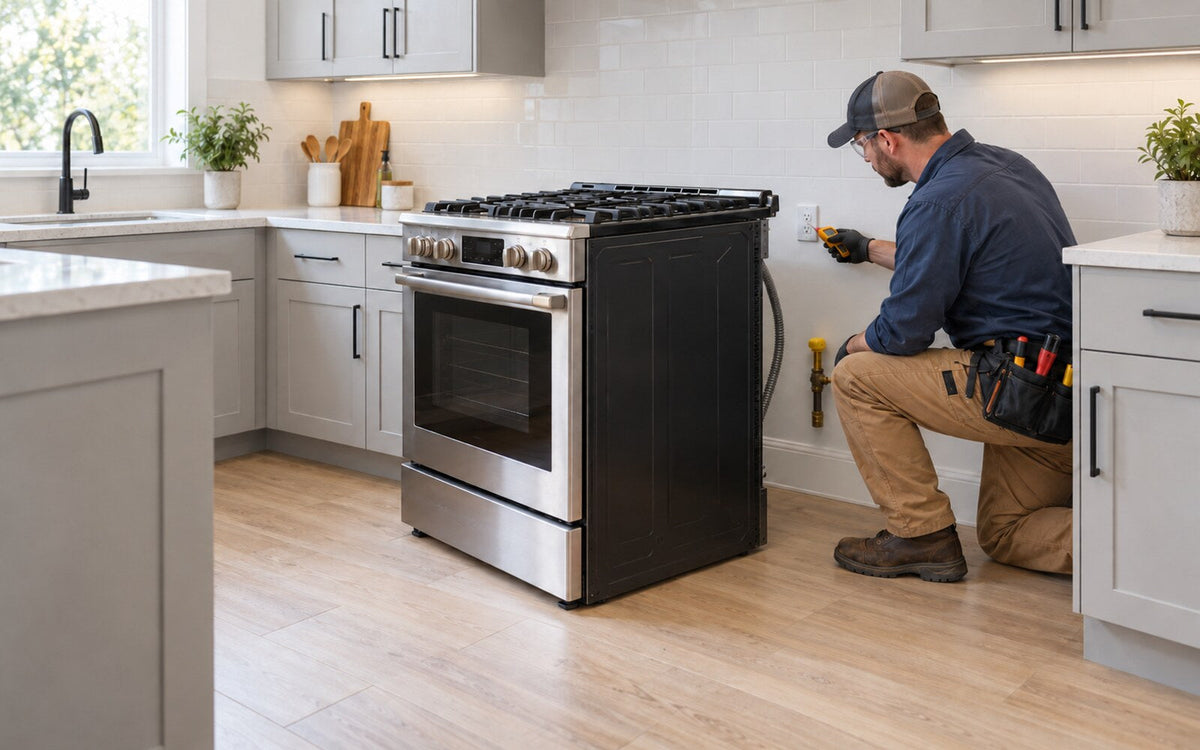
Switching from an electric stove to a gas stove requires two separate pieces: a suitable gas hookup and a safe 125-volt electrical connection for the gas range. If the existing receptacle is a four-prong NEMA 14-50 outlet, an adapter designed to provide a NEMA 5-15/20 connection may let you use that outlet without rewiring it. Confirm the appliance requirements first, and use licensed professionals for gas work or any electrical condition you are not qualified to evaluate.
What You Need Before Switching to a Gas Stove
A gas range cannot be installed on electrical power alone. The home must already have an appropriate gas hookup, and the new appliance must be compatible with that supply. The range also needs electricity for functions such as its controls and ignition, so the existing power connection still matters.
Before choosing an adapter or scheduling installation, confirm:
- The home has the required gas hookup for the new range.
- The appliance manual calls for a standard 125-volt household connection.
- The existing range receptacle is a four-prong NEMA 14-50 outlet.
- The receptacle, wiring, and surrounding area show no visible damage.
A licensed plumber or qualified gas technician should install or modify the gas connection. Ask a licensed electrician to inspect the outlet or wiring if the receptacle is damaged, incorrectly wired, unfamiliar, or different from the connection described here.
NEMA 14-50 vs. NEMA 5-15: The Key Difference
Most electric stoves and ranges use a NEMA 14-50 plug. The matching 50-amp receptacle can provide both 125-volt and 250-volt power. A gas stove, by contrast, commonly uses a standard NEMA 5-15 plug for 125-volt household power.
That difference is why a purpose-built 14-50-to-5-15/20 adapter can be useful. The adapter does not create a gas supply and does not change the range itself. It only provides the household-style electrical connection described in the appliance requirements.
How to Plan the Conversion
- Read the new range manual. Confirm its gas and electrical requirements before buying an adapter or arranging installation.
- Identify the existing receptacle. Verify that it is a four-prong NEMA 14-50 range outlet, not a different NEMA configuration.
- Choose the connection style. Decide whether you need one household-style outlet or several outlets near the range area.
- Select a purpose-built adapter. Match the NEMA 14-50 source to the NEMA 5-15 or 5-20 connection required by the appliance.
- Schedule professional installation. Have a qualified gas professional handle the fuel connection and a licensed electrician address any outlet, wiring, or compatibility concern.
- Inspect before use. Do not use a loose, scorched, cracked, wet, or otherwise damaged outlet, plug, cord, or adapter.
AC WORKS® Adapter Options Mentioned in the Video
For a single household-style connection, the video identifies the AC WORKS® AD1450520 compact adapter and the S1450CB520 adapter as two straightforward options.
If you need more than one outlet in the area, the video also names the S1450CBF520, S1450F520-018, S1450PDU, and PB1450PDU. The PB1450PDU uses a piggyback-style plug for situations where access to the same range outlet must be retained. Review the AC WORKS® 14-50 outlet solutions to compare the available configurations.
Use only the configuration that matches the source receptacle and the appliance plug. An adapter does not increase the available power, correct a wiring problem, or make an incompatible connection safe.
Electrical and Gas Safety Checklist
- Turn the range circuit off before inspecting or connecting equipment.
- Never work on exposed conductors or modify a receptacle unless you are qualified and authorized to do so.
- Do not force a plug into a receptacle or use an adapter with a different NEMA configuration.
- Keep cords and adapters dry, fully seated, and away from hot surfaces or pinch points.
- Stop using any connection that becomes loose, unusually warm, discolored, or damaged.
- Use a licensed electrician when the outlet type, wiring condition, grounding, or circuit suitability is uncertain.
- Use a qualified gas professional for the range's gas connection, leak testing, and code-compliant installation.
Common Mistakes to Avoid
Do not assume every large range outlet is NEMA 14-50. Similar-looking connections can have different wiring and ratings. Do not treat the adapter as a substitute for the required gas hookup, and do not choose an adapter by shape alone. The source receptacle, adapter, and appliance plug must be identified by their NEMA configurations and matched to the appliance requirements.
Frequently Asked Questions
Can I use an electric range outlet for a gas stove?
If the existing outlet is a four-prong NEMA 14-50 receptacle and the gas stove requires standard 125-volt household power, a purpose-built 14-50-to-5-15/20 adapter may provide the needed electrical connection. Confirm the appliance manual and the outlet condition first.
Does an adapter convert an electric stove into a gas stove?
No. The adapter only changes the available electrical connection. The home still needs a suitable gas hookup, and a qualified professional should complete the gas installation.
What plug does a gas stove use?
The video describes gas stoves as using a standard NEMA 5-15 plug for 125-volt household power. Always confirm the exact requirement in the manual for your appliance.
What if I need more than one outlet near the range?
The video identifies multi-outlet options including the S1450CBF520, S1450F520-018, S1450PDU, and PB1450PDU. Choose only a configuration that matches the existing NEMA 14-50 source and the connected equipment.
When should I call a licensed electrician?
Call a licensed electrician if you cannot positively identify the receptacle, if the outlet or wiring appears damaged, if grounding or circuit suitability is uncertain, or if any electrical modification is required.
Share:
Most Common Generator Outlet Types: NEMA 5-20, L5-30, L14-30 & TT-30
Does a Locking 50A 125/250V Connection Have Four Prongs? Hidden Ground Contact.