


Overview
Lately, there has been quite a bit of confusion surrounding two very similar-looking twist-lock plugs: the NEMA L5-30 and NEMA L6-30. Because both share a 3-prong locking design and handle 30-amp loads, people frequently mistake one for the other. Connecting equipment to the wrong voltage source causes immediate power failures or severe electrical damage. Clearing up these design differences keeps your equipment running smoothly and safely on the job site or at home.
Key Technical Differences and Visual Identifiers
The fundamental difference between these two twist-lock connections lies in their voltage ratings and internal wiring configurations. The NEMA L5-30 supplies up to 125 volts using three wires: a ground (G), a neutral (W), and a single hot (X). Conversely, the NEMA L6-30 delivers up to 250 volts across three wires: a ground (G) and two separate hot legs (X and Y).
If the stamped voltage rating on your connector body wears off over time, you can inspect the terminal letter markings directly on the face. Seeing both an X and Y marking without a W indicates a 250-volt L6-30 connection, while seeing a G, W, and X configuration confirms a 125-volt L5-30 line. Physical dimensions also differ slightly between the two options. The prongs on an L6-30 plug are slightly longer and spaced further apart, preventing you from physically forcing a 250-volt plug into a 125-volt receptacle.
Real-World Applications and Choosing the Right Cable
A customer recently reached out to us while helping supply equipment for a data center build under tight deadlines. Their technical crew needed reliable 30-amp, 250-volt power connections for equipment used on-site, including industrial air compressors, heavy-duty shop tools, and other high-capacity equipment connected to a commercial backup generator setup.
For these temporary high-voltage power runs, the AC WORKS® L630PR Locking Extension Cord provided a dedicated extension solution, allowing 30-amp, 250-volt connections to stay securely locked during continuous operation.
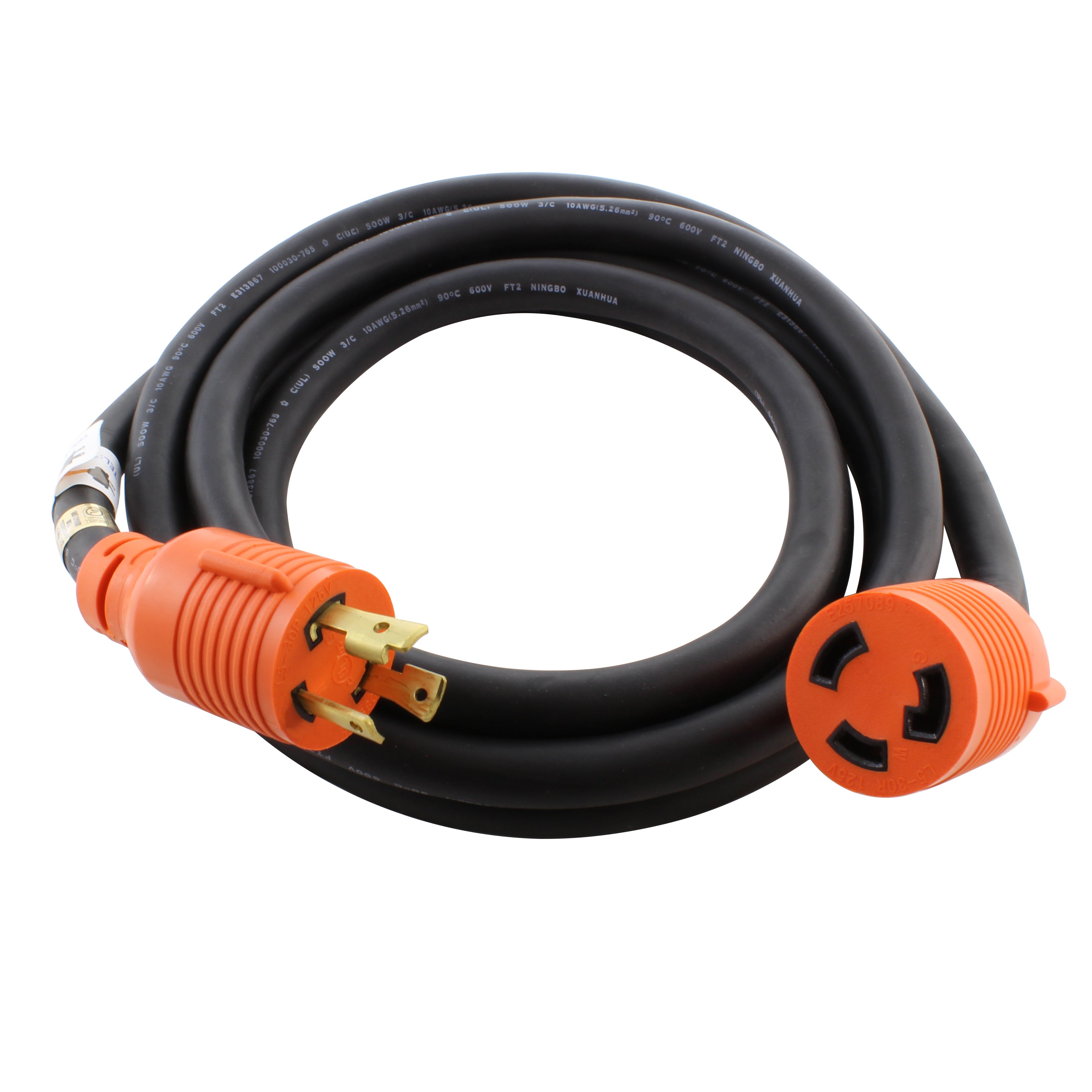
L630PR Locking 30 Amp Extension Cord, featured here:

On the other hand, another customer reached out preparing their home for peak hurricane season, wanting to keep basic household essentials running during a blackout. They needed temporary emergency power to feed a refrigerator, a chest freezer, a window air conditioner, and a microwave, keeping total power demand safely under 3,750 watts. Relying on an AC WORKS® L530PR Generator Extension Cord allowed them to safely deploy temporary emergency power directly from their generator without risking voltage overloads or loose plugs.
L530PR Locking 30 Amp Extension Cord, featured here:
 The Big Takeaway
While NEMA L5-30 and L6-30 plugs both feature 30-amp twist-lock designs, they are strictly non-interchangeable due to operating at 125 volts versus 250 volts. Always verify the letter markings on the plug face or check prong spacing before matching your cables to a generator or shop tool.
If you remain uncertain about which connection your setup requires, send our team a quick photo, and we will identify the correct configuration for you. Be sure to check out the rest of our blogs for more technical breakdowns, product spotlights, and electrical safety guides!
Frequently Asked Questions
Can I force a NEMA L5-30 plug into a NEMA L6-30 receptacle?
No, you cannot. Although both connectors are 3-prong twist-lock styles rated for 30 amps, the L6-30 prongs are physically larger, slightly longer, and spaced wider apart to prevent accidental cross-mating between 125-volt and 250-volt systems.
What do the letters G, W, X, and Y stand for on the plug face?
The terminal letters indicate internal wiring functions: G represents the Ground wire, W represents the Neutral wire (white), and X and Y represent live Hot wires. An L5-30 connection features G, W, and X, while an L6-30 connection features G, X, and Y.
What equipment typically uses an L5-30 vs. an L6-30 connection?
The 125-volt NEMA L5-30 connection is ideal for running essential household loads up to 3,750 watts (like fridges, freezers, and microwaves) during temporary emergency power situations, as well as food trucks and 30-amp RVs. The 250-volt NEMA L6-30 connection is typically used for data center server rack PDUs, large shop air compressors, commercial welders, plasma cutters, and high-voltage backup generators.
Why is a locking connection necessary for generators and outdoor equipment?
Twist-lock connections like the L5-30 and L6-30 prevent accidental disconnects caused by physical tension, vibrations from running generator engines, or heavy foot traffic around job sites and workshop environments.
Check out one of our most popular videos, that quickly explains the differences between L630 and L530!

Share:
Why You Can’t Power 220-Volt Appliances with a Standard Plug
How to Change Gen 2/3 Mobile Connector?